Maxis–Axiata competitive growth through automation
By 2 November 2026, complete separate Maxis and CelcomDigi closed-loop automation pilots covering 10,000 consented relationships per operator and demonstrate…
Full framing
By 2 November 2026, complete separate Maxis and CelcomDigi closed-loop automation pilots covering 10,000 consented relationships per operator and demonstrate a measurable increase in modeled active relationships, while provisioning completion remains at least 98%, risk churn no more than 2%, coverage setting at least 75%, capacity headroom at least 15%, and capacity pressure no more than 85%, with no price or catalog writes and no automatic scale-up.
Instrument evidence
One exact state for each modeled layer
Required evidence gap · Incident Sim
No verified Incident Sim scene is present
This Gate-A faculty has no snapshot bound to the published Study.
The finding cannot claim visual evidence from this required layer.
Register and verify the exact Incident Sim state, then publish a revised Study.
Required evidence gap · Product Launch Sim
No verified Product Launch Sim scene is present
This Gate-A faculty has no snapshot bound to the published Study.
The finding cannot claim visual evidence from this required layer.
Register and verify the exact Product Launch Sim state, then publish a revised Study.
Required evidence gap · Cidx
No verified Cidx scene is present
This Gate-A faculty has no snapshot bound to the published Study.
The finding cannot claim visual evidence from this required layer.
Register and verify the exact Cidx state, then publish a revised Study.
Required evidence gap · Comdyn
No verified Comdyn scene is present
This Gate-A faculty has no snapshot bound to the published Study.
The finding cannot claim visual evidence from this required layer.
Register and verify the exact Comdyn state, then publish a revised Study.
Claim-bound findings What the evidence supports—and how strongly 5 bound claims
- projected
In the 180-day, 1,000,000-relationship decision model, acquisition-only automation ended with 565,627 retained and 281,814 churned relationships versus the baseline's 558,661…
Full claim wording
In the 180-day, 1,000,000-relationship decision model, acquisition-only automation ended with 565,627 retained and 281,814 churned relationships versus the baseline's 558,661 retained and 272,581 churned; the balanced acquisition, activation, retention and win-back setting ended with 795,677 retained and 135,661 churned. These are modeled outcomes, not operator observations.
- projected
In the seeded Malaysia growth simulation at week 104, baseline active subscriptions were 107,901.9; funnel-and-retention automation alone produced 110,412.2, while the same…
Full claim wording
In the seeded Malaysia growth simulation at week 104, baseline active subscriptions were 107,901.9; funnel-and-retention automation alone produced 110,412.2, while the same automation with the coverage setting raised to 75 produced 124,509.9. The model therefore treats coverage readiness as a material gate on automation-led growth.
- projected
The unchanged Malaysia product baselines are directionally different: Maxis ONE Ultra reaches its modeled 10% adoption threshold after 85 weeks for 180,000 devices, while…
Full claim wording
The unchanged Malaysia product baselines are directionally different: Maxis ONE Ultra reaches its modeled 10% adoption threshold after 85 weeks for 180,000 devices, while CelcomDigi Postpaid 5G needs 337.463 weeks for 680,000 devices and lies outside the 312-week trajectory horizon. Because the products have different TAM and launch assumptions, this is a sequencing signal rather than a causal operator ranking.
- supported
Capability boundary: the Desk OSS/BSS records and both Malaysia Incident Twin raster catalogs are simulated weak proxies, not live Maxis or CelcomDigi inventory or counters.…
Full claim wording
Capability boundary: the Desk OSS/BSS records and both Malaysia Incident Twin raster catalogs are simulated weak proxies, not live Maxis or CelcomDigi inventory or counters. Before activation, the receiver must resolve the real operator-specific CRM, order, activation, assurance and RAN endpoints; failure to resolve any one of them is a hard stop, not permission to substitute modeled data.
- illustrative
Operational plan for review: use existing eligible offers with no product, price, catalog, charging, entitlement or policy change; read consent, eligibility and order state;…
Full claim wording
Operational plan for review: use existing eligible offers with no product, price, catalog, charging, entitlement or policy change; read consent, eligibility and order state; submit only accepted pilot orders through existing activation paths; configure separate Maxis and CelcomDigi acquisition, onboarding, retention, recovery and win-back workflows for 12 weeks and 10,000 consented relationships per operator. Release cohorts only after provisioning completion is at least 0.98, the coverage setting is at least 75, capacity headroom is at least 0.15 and capacity pressure is no more than 0.85. Monitor active subscriptions, net adds, churn, provisioning and service readiness separately each week; never scale automatically. Stop on consent breach, duplicate contact or any threshold failure, then freeze intake, stop new messages, cancel only unsubmitted or unaccepted pilot orders, honor issued commitments and route accepted orders and exceptions to manual assurance.
Handoff to network / automation
Continue from analysis into governed implementation
Bounded operational handoff · DOIL
Operate two separate, consented 12-week closed-loop growth pilots for Maxis Malaysia and CelcomDigi, each capped at 10,000 relationships,…
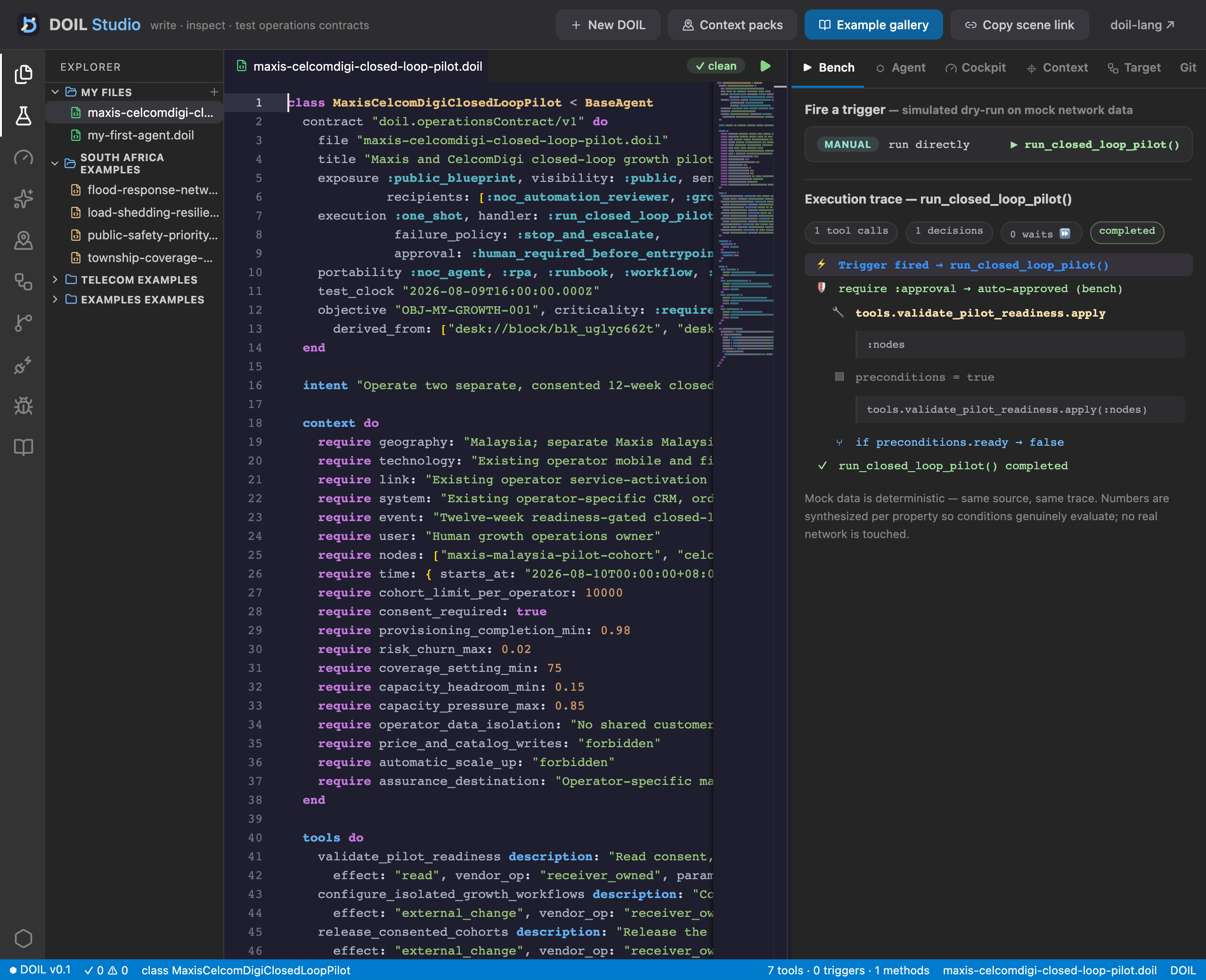
Maxis and CelcomDigi closed-loop growth pilot
Review scope, controls and rollback 8/8 required structural checks passed
Full bounded objective
Operate two separate, consented 12-week closed-loop growth pilots for Maxis Malaysia and CelcomDigi, each capped at 10,000 relationships, with no price or catalog writes and with service-readiness gates before cohort release or later scale-up.
What changes
- Submit only accepted pilot orders through each operator's existing activation path after the readiness gate.
- Configure separate acquisition, onboarding, retention, recovery and win-back branches for Maxis Malaysia and CelcomDigi.
- Start consented customer messages and service-recovery branches only for released cohort members.
- Release one Maxis Malaysia cohort and one CelcomDigi cohort only after a human approves the complete readiness packet.
- On failed verification, freeze new intake, stop new messages, cancel only unsubmitted or unaccepted orders, honor issued commitments, and route accepted orders and exceptions to manual assurance.
Where
- Service specification and activation · Orders created by the two capped pilot cohorts; accepted orders are never force-cancelled.
- Campaign, onboarding, referral and distribution · Twelve weeks; 10,000 consented relationships per operator; no shared customer data pool and no price or catalog writes.
- Campaign, onboarding, referral and distribution · Each operator's isolated pilot workflow; issued customer commitments remain honored after a stop.
- Staged rollout, gates, stopping and rollback · 10,000 consented relationships per operator for 12 weeks; no automatic national scale-up.
- Staged rollout, gates, stopping and rollback · Both operator pilots; no rollback affects accepted orders or customer commitments already issued.
Activation
- Validate eligibility, activation and service readiness — manual, no approval gate; widens when Both isolated cohorts are consented and eligible, provisioning completion is at least 0.98, coverage setting is at least 75, capacity headroom is at least 0.15 and capacity pressure is no more than 0.85.
- Configure the two isolated closed-loop workflows — approval gated, human approval required; widens when A human verifies the two operator workflows are isolated and match every approved boundary.
- Release cohorts and start the closed-loop pilot — approval gated, human approval required; widens when Complete the 12-week pilot and present separate Maxis Malaysia and CelcomDigi outcome packets; never scale automatically.
- Observe outcomes and close for human decision — scheduled, no approval gate; widens when A human reviews the complete week-12 outcome and service-readiness packet before selecting any scale-up action.
Monitoring
- Workflow configuration and boundary values against Exactly 12 weeks, 10,000 relationships per operator, no shared customer data, and no price or catalog writes., published to assurance_destination
- Provisioning completion against at least 0.98, published to assurance_destination
- Risk-churn rate against no more than 0.02, published to assurance_destination
- Coverage setting against at least 75, published to assurance_destination
- Capacity headroom against at least 0.15, published to assurance_destination
- Capacity pressure against no more than 0.85, published to assurance_destination
- Active relationships, net adds and churned total against Reported separately for Maxis Malaysia and CelcomDigi every week., published to assurance_destination
Stop and rollback
- Validate eligibility, activation and service readiness: Any required source or receiver endpoint is unresolved or stale.
- Validate eligibility, activation and service readiness: Either operator cohort exceeds 10,000 relationships.
- Validate eligibility, activation and service readiness: Consent or service-readiness checks fail.
- Configure the two isolated closed-loop workflows: Any workflow can write price or catalog state. → On failed verification, freeze new intake, stop new messages, cancel only unsubmitted or unaccepted orders, honor issued commitments, and route accepted orders and exceptions to manual assurance.
- Configure the two isolated closed-loop workflows: The operators' customer-level data are pooled. → On failed verification, freeze new intake, stop new messages, cancel only unsubmitted or unaccepted orders, honor issued commitments, and route accepted orders and exceptions to manual assurance.
- Configure the two isolated closed-loop workflows: A configured value differs from the approved boundary. → On failed verification, freeze new intake, stop new messages, cancel only unsubmitted or unaccepted orders, honor issued commitments, and route accepted orders and exceptions to manual assurance.
- Release cohorts and start the closed-loop pilot: Consent breach or duplicate contact is detected. → On failed verification, freeze new intake, stop new messages, cancel only unsubmitted or unaccepted orders, honor issued commitments, and route accepted orders and exceptions to manual assurance.
- Release cohorts and start the closed-loop pilot: Provisioning completion falls below 0.98. → On failed verification, freeze new intake, stop new messages, cancel only unsubmitted or unaccepted orders, honor issued commitments, and route accepted orders and exceptions to manual assurance.
- Release cohorts and start the closed-loop pilot: Risk-churn rate rises above 0.02. → On failed verification, freeze new intake, stop new messages, cancel only unsubmitted or unaccepted orders, honor issued commitments, and route accepted orders and exceptions to manual assurance.
- Release cohorts and start the closed-loop pilot: Coverage setting falls below 75. → On failed verification, freeze new intake, stop new messages, cancel only unsubmitted or unaccepted orders, honor issued commitments, and route accepted orders and exceptions to manual assurance.
- Release cohorts and start the closed-loop pilot: Capacity headroom falls below 0.15. → On failed verification, freeze new intake, stop new messages, cancel only unsubmitted or unaccepted orders, honor issued commitments, and route accepted orders and exceptions to manual assurance.
- Release cohorts and start the closed-loop pilot: Capacity pressure rises above 0.85. → On failed verification, freeze new intake, stop new messages, cancel only unsubmitted or unaccepted orders, honor issued commitments, and route accepted orders and exceptions to manual assurance.
- Observe outcomes and close for human decision: Outcome data are missing, pooled across operators or not reproducible.
Operational domains
- Product and commercial configuration Out of scope · The chosen pilot tests orchestration around existing eligible offers; it makes no product, eligibility, price or lifecycle change.
- BSS catalog, charging, CRM and ordering Planned · simulated grounding
- Service specification and activation Planned · simulated grounding
- Core-network entitlement, policy and charging Out of scope · The pilot does not change subscriber entitlement, policy control or charging rules; it uses existing service behavior and stops if those dependencies are unresolved.
- RAN coverage and capacity Planned · simulated grounding
- Campaign, onboarding, referral and distribution Planned · simulated grounding
- Assurance, monitoring and feedback Planned · simulated grounding
- Staged rollout, gates, stopping and rollback Planned · simulated grounding
Limits carried forward
- This is DOIL-authored local review material. Desk coordinates and renders it but does not infer language semantics from compiler internals.
- The single .doil file is the sole portable operations contract. This projection, its package, IR, and receipts are derived review material and are not required by the receiver.
- The pinned contract-test clock is validation evidence, not the current time. A receiver must re-evaluate expiry and all time-sensitive preconditions at consumption.
- Exact source, fixtures, lineage, and deterministic observations are review evidence only; they do not certify semantic correctness or prove untested paths.
- No human approval, target authority, target generation, deployment, scheduling, network call, or external effect is performed by this handoff.
- A target-side generator must recompile the exact workspace with a supported DOIL verifier and preserve every approved requirement, guardrail, bound, approval, observation, recovery, and output.
- The reference preview completed as a zero-record structural preview; it contains no action or scenario evidence.
- This package preserves intent and structural proofs only; no target has certified it.
- Approval declarations are preserved as intent; this tool does not grant human authority.
- Future targets are portability labels only; no target-specific generator or adapter ran.
- The content-addressed Studio state becomes replayable after Desk persists the included StateDoc.
Exact structural evidence
The score and level measure source-structure declaration coverage for the selected profile only. A production-shaped level is not post-investigation Desk handoff eligibility, semantic validation, human approval, certification, live-network validation, target readiness, deployment authority, or execution authority.
Source checks
- Clean parse · No parser diagnostics
- Top-level definition · Agent, class, or pipeline definition exists
- Purpose text · Intent or description is declared
- Context hydration · Runtime context requirements and sources are explicit
- Data sources · Data inputs are named; intentionally not applicable to this strict contract
- Tool surface · Allowed actions are declared
- Triggers · Activation paths are declared; intentionally not applicable to this strict contract
- Runnable methods · Handlers or methods are defined
- Guardrails · Pre, during, or post execution controls are declared
- Lifecycle · Timeout, health, or restart policy is declared; intentionally not applicable to this strict contract
- Observability · Logs, metrics, alerts, or reports are declared; intentionally not applicable to this strict contract
- Recovery · Retry, escalation, or dead-letter policy is declared; intentionally not applicable to this strict contract
- Output/promotion · Generated plans and approval stages are declared
Handoff checks
- Strict Operations Contract Complete · The sole .doil file declares every strict operations-contract facet; all other views are derived.
- Parse Clean · Every workspace file parsed without diagnostics.
- Brief Complete · A title and objective are required to preserve the human intent.
- Approved Intent Textually Bound · Every approved requirement is bound exactly once to its full text in the DOIL source for human semantic review.
- Scenario Coverage Ready · No source-owned scenario fixtures were declared or run; structural readiness makes no scenario-coverage claim.
- Target Kind Requested · At least one future portability target must be selected; no target artifact is generated here.
- Tool Effects Explicit · Every declared tool states its backend-neutral effect as read, propose, or external_change.
- Post Investigation Operational Remedy · The selected entrypoint reaches an explicit external_change request: Desk investigation is upstream, while this handoff specifies the approved operational remedy.
- Launch Selector Unambiguous · The explicit handler or trigger resolves to one entrypoint.
- Entrypoint Resolved · Reference preview resolved run_closed_loop_pilot.
- Reference Preview Completed · The deterministic reference preview completed without granting authority or producing external effects.
- Execution Mode Matches Source · Execution mode agrees with the selected source entrypoint.
- Repeatable Mode Bounded · Execution intent is one-shot or carries an explicit maxCycles/expiresAt bound.
- Expiry After Contract Test Clock · Any declared expiry is later than the fixed source-owned contract-test clock; current-time validity is not assessed.
- Clock Pinned · The reference preview uses the source-owned fixed contract-test clock and contains no current-time or wall-clock claim.
Executive readout
Decision summary
Decision boundary
- Chosen action: Pilot one closed-loop growth workflow — Each operator gets a measurable acquisition-to-retention workflow before national scale. (receiver: n8n).
Review 1 full note
- 8 cited items were available to this study and are not in it: 1 DOIL handoff, 1 feed citation, 3 scenes cut from the page; 2 action proposals, 1 DOIL handoff never placed.
How this was governed
81% autonomous · 3 human checkpoints (gate_a & gate_b & gate_b)
Verification
- Supported claims1
- Projected3
- Illustrative1
Evidence
- Cited (source)4
- Modeled5
- Observational1