Pilbara cyclone response
When a Zelia-class cyclone cuts Port Hedland's fibre, the 30-minute target holds only if customers are notified at the first cut read and each mine-site LEO batch is approved…
Full framing
When a Zelia-class cyclone cuts Port Hedland's fibre, the 30-minute target holds only if customers are notified at the first cut read and each mine-site LEO batch is approved fast. The hand-off pages at minute 15 and names every circuit still down at minute 30. Modelled on a synthetic network; nothing deployed.
Faculty evidence
One exact state for each modeled layer
Chapter 1 · incident-sim
Where the cyclone cuts: Port Hedland on the live twin
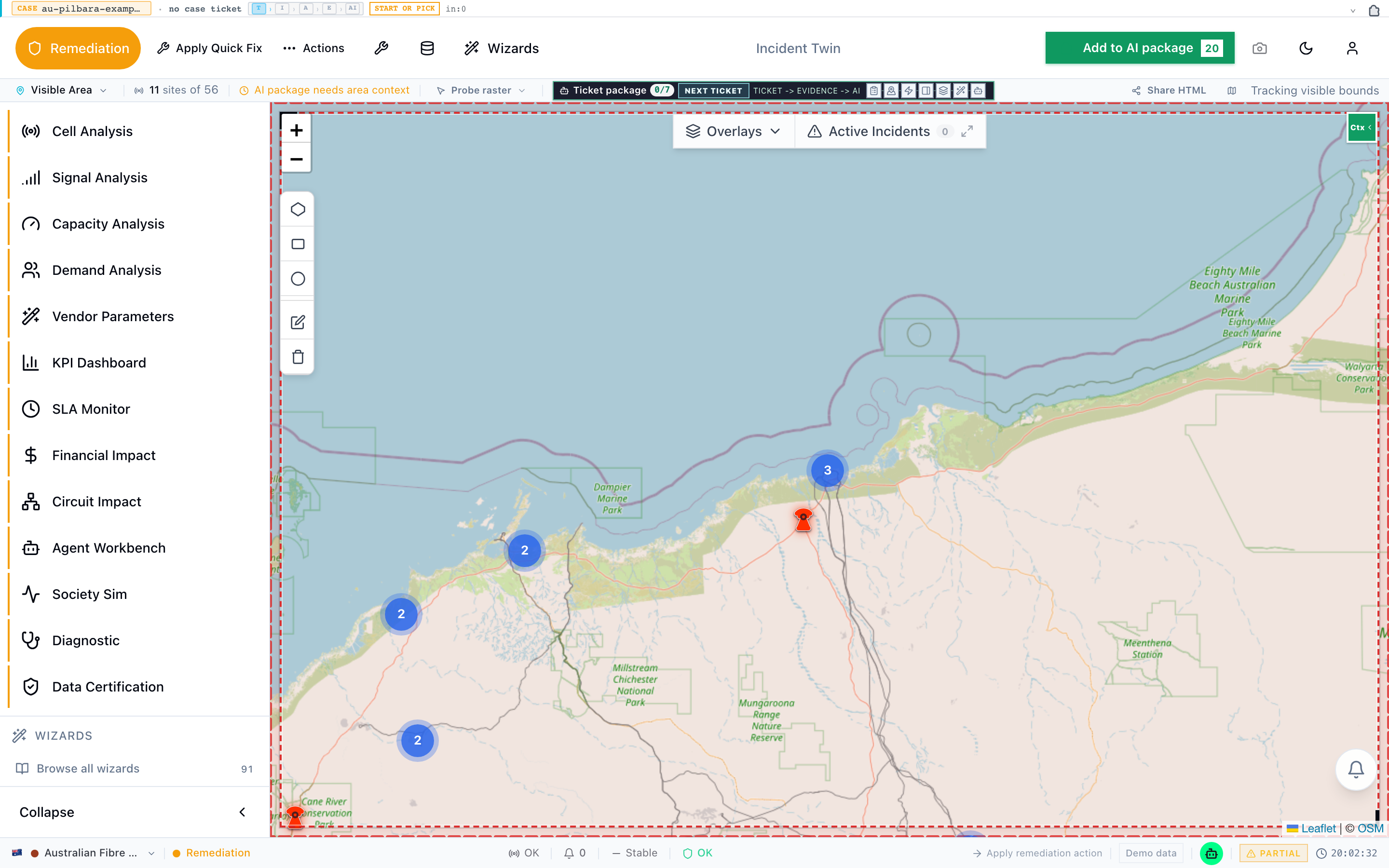
Base view of the synthetic au-pilbara twin around Port Hedland, before any cut area or ticket is in the state. It shows the network, not the cut; the cut area comes back from the…
Boundary Only circuits inside the cut area enter the LEO switch and the notice list, so this area bounds the 30-minute work.
Base view of the synthetic au-pilbara twin around Port Hedland, before any cut area or ticket is in the state. It shows the network, not the cut; the cut area comes back from the reader.
Only circuits inside the cut area enter the LEO switch and the notice list, so this area bounds the 30-minute work.
Draw the cut area around the Port Hedland POP on the map, attach it to ticket tkt_mvh3dgsvhi9h9xz24m, then choose Send adjustment back.
The returned area is checked against the drill's cut spans before any action is proposed.
Chapter 2 · incident-sim
The cut corridor: Port Hedland POP to the highway junction
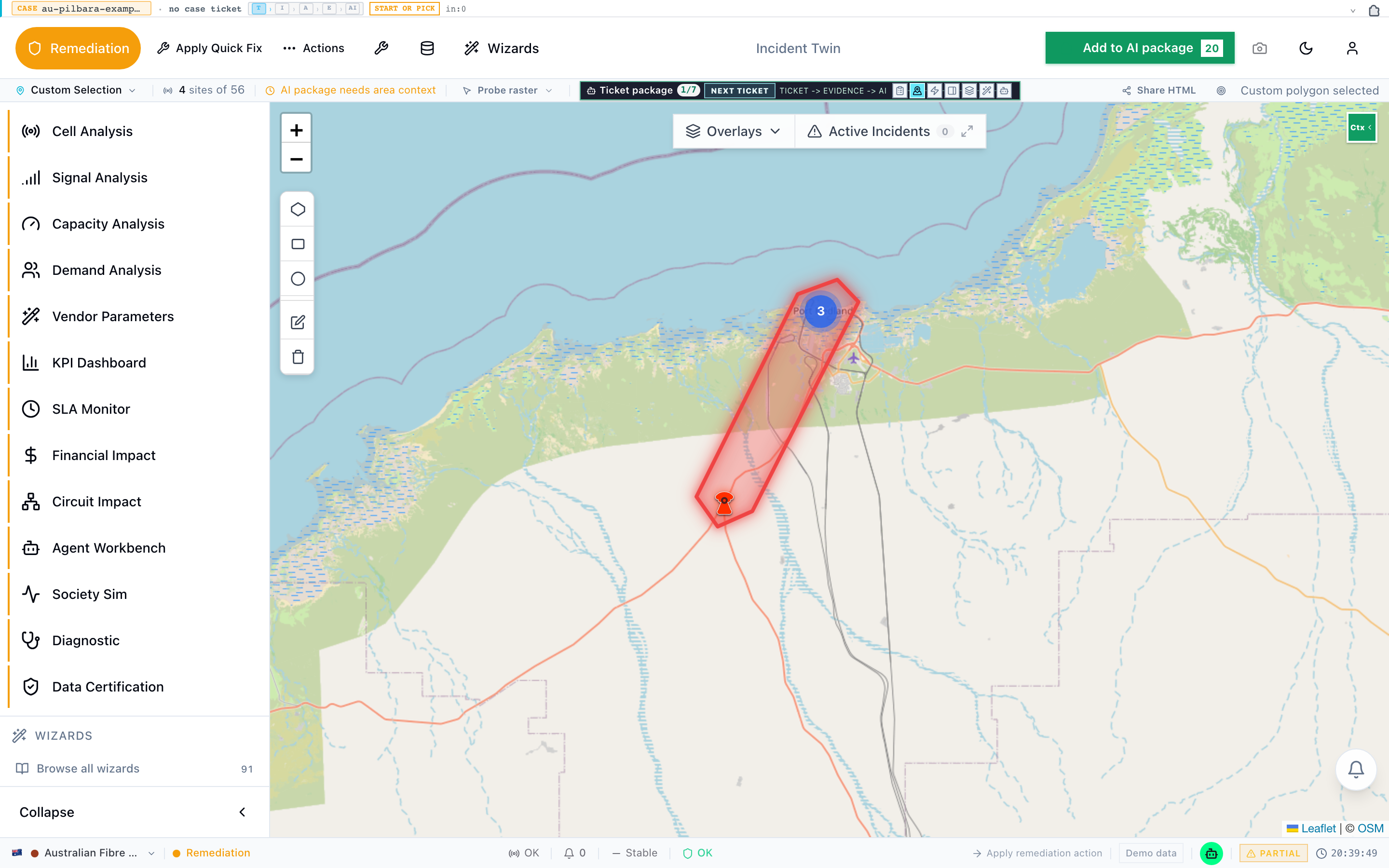
The reader's 318.57 km² corridor holds the four Port Hedland nodes the drill cuts. The twin shows no live outage there and its radio rasters do not measure fibre, so the cut…
Boundary The drill's cut spans meet at these four nodes, so the LEO switch and the notice list start here; the chosen option…
The reader's 318.57 km² corridor holds the four Port Hedland nodes the drill cuts. The twin shows no live outage there and its radio rasters do not measure fibre, so the cut itself is Register's drill.
The drill's cut spans meet at these four nodes, so the LEO switch and the notice list start here; the chosen option acts on circuits cut in this corridor.
Open Circuit Impact for this corridor to see which circuits ride its spans.
Next: choose what to do about the 30-minute clock.
Claim-bound findings What the evidence supports—and how strongly 7 bound claims
- supported
Modeled (CIDX, Zelia drill counts): cust-port-authority carries the heaviest 30-minute response load, 0.5, with three circuits down and no fallback; cust-mine-christmas-creek and…
Full claim wording
Modeled (CIDX, Zelia drill counts): cust-port-authority carries the heaviest 30-minute response load, 0.5, with three circuits down and no fallback; cust-mine-christmas-creek and cust-mine-cloudbreak follow at 0.4667, the only two customers with a First circuit to switch to LEO.
- supported
Modeled (Comdyn, rates authored): with switching and notices each at 0.1 per minute, at minute 30 about 4.39% of cut First circuits are still down and 95.02% of customers are…
Full claim wording
Modeled (Comdyn, rates authored): with switching and notices each at 0.1 per minute, at minute 30 about 4.39% of cut First circuits are still down and 95.02% of customers are notified; at 0.155 per minute, 0.84% are still down and 99.04% notified. The modeled tail never reaches zero.
- projected
Register's drill fact au-pilbara-cyclone-zelia (incident-sim, rule computeCircuitImpact, export sha256 7709a0a75a5e99f37d4027d9cd2725f1e5b3b9c696270059ca646f307ef5f4bd) cuts nine…
Full claim wording
Register's drill fact au-pilbara-cyclone-zelia (incident-sim, rule computeCircuitImpact, export sha256 7709a0a75a5e99f37d4027d9cd2725f1e5b3b9c696270059ca646f307ef5f4bd) cuts nine spans at and around the Port Hedland POP; this Study re-draws that cut area on the live twin before relying on it.
- projected
The cut area returned in round 0 is larger than Incident Sim's comparison limit, so it cannot be compared yet; a narrower corridor from the Port Hedland POP to the Hedland…
Full claim wording
The cut area returned in round 0 is larger than Incident Sim's comparison limit, so it cannot be compared yet; a narrower corridor from the Port Hedland POP to the Hedland highway junction still holds the four drill nodes there.
- projected
Answer (modeled, not observed): the 30-minute target needs notices sent at the first cut read and LEO batches switched without waiting on slow approval, plus an escalation before…
Full claim wording
Answer (modeled, not observed): the 30-minute target needs notices sent at the first cut read and LEO batches switched without waiting on slow approval, plus an escalation before minute 30; at the modeled 0.1 per minute rates the target is missed.
- supported
Incident Sim compared the exact returned corridor (318.5712 km²): the twin's coverage raster has no values there and demand density averages 0.005765 Mbps/km², so its radio…
Full claim wording
Incident Sim compared the exact returned corridor (318.5712 km²): the twin's coverage raster has no values there and demand density averages 0.005765 Mbps/km², so its radio rasters do not measure the fibre cut; the cut remains Register's drill fact.
- projected
Register's drill fact au-pilbara-cyclone-zelia (Incident Sim, rule computeCircuitImpact, synthetic au-pilbara network) cuts nine spans at and around Port Hedland: 17 circuits…
Full claim wording
Register's drill fact au-pilbara-cyclone-zelia (Incident Sim, rule computeCircuitImpact, synthetic au-pilbara network) cuts nine spans at and around Port Hedland: 17 circuits down, 10 degraded, 13 up, 2 to LEO fallback. Cited by export hash; not re-run in this Study.
Handoff to network / automation
Continue from analysis into governed implementation
Bounded operational handoff · DOIL
When a severe tropical cyclone's forecast track crosses the Pilbara corridor, then at the first circuit-impact read showing a cut: notify…
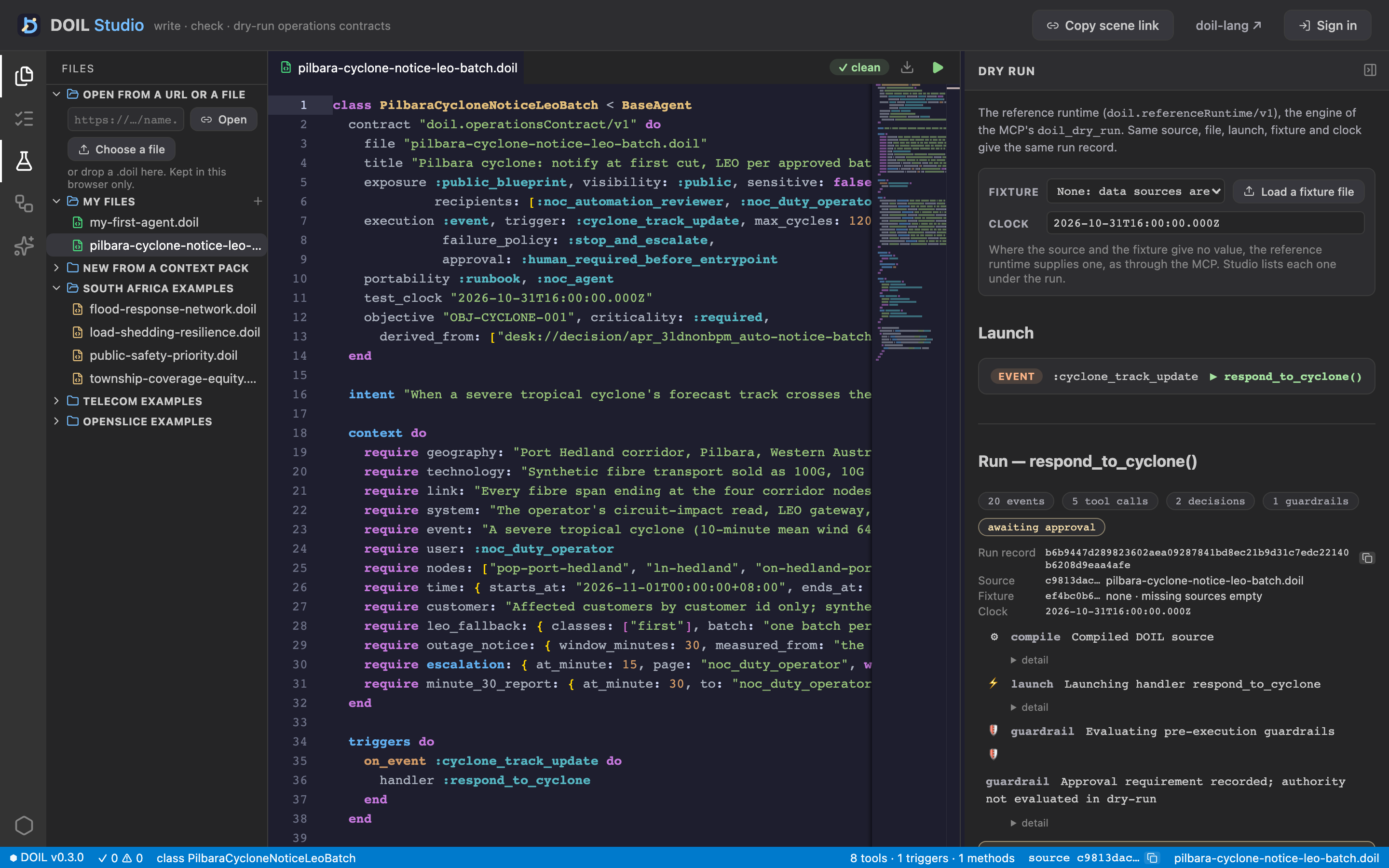
Pilbara cyclone: notify at first cut, LEO per approved batch
Review scope, controls and rollback 9/9 required structural checks passed
Full bounded objective
When a severe tropical cyclone's forecast track crosses the Pilbara corridor, then at the first circuit-impact read showing a cut: notify every affected customer by id within 30 minutes without waiting for approval and keep the receipts; switch each mine-site batch of cut First-class circuits to its LEO fallback only after the duty operator approves that batch, paging the operator again at minute 15 for any batch still unapproved; and at minute 30 report by name every First circuit still down.
What changes
- Each mine-site batch of cut First circuits moves to its LEO fallback path once the duty operator approves that batch.
- A circuit returns from its LEO fallback path when the LEO read shows the switch did not carry.
- Every affected customer gets an outage notice at the first cut read, without waiting for approval, and the receipt is kept.
- A customer notified on a false cut read gets a correction notice.
Where
- Service specification and activation · First-class circuits with a cut fibre path, one batch per mine site, at most 20 circuits per batch
- Service specification and activation · Only circuits switched by this contract
- Assurance, monitoring and feedback · Every affected customer id in the corridor cut; 30-minute window
- Assurance, monitoring and feedback · Only customers this contract notified
Activation
- Notify every affected customer at the first cut read — event, human approval required; widens when Every affected customer id has a delivered notice receipt.
- Switch each mine-site batch of cut First circuits to LEO after operator approval — approval gated, human approval required; widens when The LEO site-state read shows the approved batch carrying on LEO.
- Page at minute 15, report by name at minute 30 — threshold, no approval gate; widens when The minute-30 report has gone to the duty operator.
Monitoring
- affected customers with a delivered notice within 30 minutes of the first cut read against every affected customer within 30 minutes, published to minute_30_report
- cut First circuits carried on LEO against every cut First circuit on LEO by minute 30, published to minute_30_report
Stop and rollback
- Notify every affected customer at the first cut read: The circuit-impact read shows no cut circuit in the corridor. → A customer notified on a false cut read gets a correction notice.
- Notify every affected customer at the first cut read: The notice channel rejects notices. → A customer notified on a false cut read gets a correction notice.
- Switch each mine-site batch of cut First circuits to LEO after operator approval: More than 2 LEO switch failures. → A circuit returns from its LEO fallback path when the LEO read shows the switch did not carry.
- Switch each mine-site batch of cut First circuits to LEO after operator approval: A batch would exceed 20 circuits. → A circuit returns from its LEO fallback path when the LEO read shows the switch did not carry.
- Page at minute 15, report by name at minute 30: Every cut First circuit is on LEO and every affected customer is notified.
Operational domains
- Product and commercial configuration Out of scope · No offering, price or eligibility changes; First-class circuits already include the LEO fallback path.
- BSS catalog, charging, CRM and ordering Out of scope · No catalog, charging, CRM or order change; notices address existing customer ids and no credit is decided here.
- Service specification and activation Planned · simulated grounding
- Core-network entitlement, policy and charging Out of scope · The change is on fibre transport and the LEO fallback path; no core entitlement or policy changes.
- RAN coverage and capacity Out of scope · Radio coverage and capacity are not changed; the twin's radio rasters do not measure the fibre cut.
- Campaign, onboarding, referral and distribution Out of scope · No acquisition or distribution mechanism changes; outage notices are handled under assurance and feedback.
- Assurance, monitoring and feedback Planned · simulated grounding
- Staged rollout, gates, stopping and rollback Planned · simulated grounding
Limits carried forward
- This is DOIL-authored local review material. Desk coordinates and renders it but does not infer language semantics from compiler internals.
- The single .doil file is the sole portable operations contract. This projection, its package, IR, and receipts are derived review material and are not required by the receiver.
- The pinned contract-test clock is validation evidence, not the current time. A receiver must re-evaluate expiry and all time-sensitive preconditions at consumption.
- Exact source, fixtures, lineage, and deterministic observations are review evidence only; they do not certify semantic correctness or prove untested paths.
- No human approval, target authority, target generation, deployment, scheduling, network call, or external effect is performed by this handoff.
- A target-side generator must recompile the exact workspace with a supported DOIL verifier and preserve every approved requirement, guardrail, bound, approval, observation, recovery, and output.
- The reference preview completed as a zero-record structural preview; it contains no action or scenario evidence.
- The reference runtime selected the named trigger handler but did not evaluate its native predicate or sustained window.
- This package preserves intent and structural proofs only; no target has certified it.
- Approval declarations are preserved as intent; this tool does not grant human authority.
- Future targets are portability labels only; no target-specific generator or adapter ran.
- The content-addressed Studio state becomes replayable after Desk persists the included StateDoc.
Exact structural evidence
Source-structure coverage only. A production-shaped level does not establish Desk handoff eligibility, semantic correctness, approval, certification, live-network validation, target readiness, deployment or execution authority.
Source checks
- Clean parse · No parser diagnostics
- Top-level definition · Agent, class, or pipeline definition exists
- Purpose text · Intent or description is declared
- Context hydration · Runtime context requirements and sources are explicit
- Data sources · Data inputs are named; intentionally not applicable to this strict contract
- Tool surface · Allowed actions are declared
- Triggers · Activation paths are declared
- Runnable methods · Handlers or methods are defined
- Guardrails · Pre, during, or post execution controls are declared
- Lifecycle · Timeout, health, or restart policy is declared; intentionally not applicable to this strict contract
- Observability · Logs, metrics, alerts, or reports are declared; intentionally not applicable to this strict contract
- Recovery · Retry, escalation, or dead-letter policy is declared; intentionally not applicable to this strict contract
- Output/promotion · Generated plans and approval stages are declared
Handoff checks
- Strict Operations Contract Complete · The sole .doil file declares every strict operations-contract facet; all other views are derived.
- Parse Clean · Every workspace file parsed without diagnostics.
- Brief Complete · A title and objective are required to preserve the human intent.
- Approved Intent Textually Bound · Every approved requirement is bound exactly once to its full text in the DOIL source for human semantic review.
- Scenario Coverage Ready · No source-owned scenario fixtures were declared or run; structural readiness makes no scenario-coverage claim.
- Target Kind Requested · At least one future portability target must be selected; no target artifact is generated here.
- Tool Effects Explicit · Every declared tool states its backend-neutral effect as read, propose, or external_change.
- Post Investigation Operational Remedy · The selected entrypoint reaches an explicit external_change request: Desk investigation is upstream, while this handoff specifies the approved operational remedy.
- Launch Selector Unambiguous · The explicit handler or trigger resolves to one entrypoint.
- Entrypoint Resolved · Reference preview resolved respond_to_cyclone.
- Reference Preview Completed · The deterministic reference preview completed without granting authority or producing external effects.
- Execution Mode Matches Source · Execution mode agrees with the selected source entrypoint.
- Repeatable Mode Bounded · Execution intent is one-shot or carries an explicit maxCycles/expiresAt bound.
- Expiry After Contract Test Clock · Any declared expiry is later than the fixed source-owned contract-test clock; current-time validity is not assessed.
- Clock Pinned · The reference preview uses the source-owned fixed contract-test clock and contains no current-time or wall-clock claim.
Methods & interaction history 1 interaction round · 2 method notes
- Round 1 Incident Simcompleted
- Asked
- Draw the cut area around the Port Hedland POP, attach it to ticket tkt_mvh3dgsvhi9h9xz24m and send it back; redrawn as a corridor after the first area exceeded the 500 km² comparison limit.
- Returned
- A six-point corridor of 318.57 km² holding the four Port Hedland drill nodes, with ticket tkt_mvh3dgsvhi9h9xz24m; no incident and no wizard.
- Changed
- Incident Sim compared the exact corridor: no coverage values there and mean demand density 0.005765 Mbps/km², so its radio rasters do not show the fibre cut.
Additional method notes
- Chosen action: Notify at first cut; LEO per batch on operator approval; page at minute 15 — Every affected customer is notified automatically at the first cut read, and each mine-site LEO batch switches once the duty operator approves it, with a second page at minute 15. (receiver: runbook).
- 4 cited items were available to this study and are not in it: 2 action proposals, 2 scenes never placed.
How this was governed
91% autonomous · 2 human checkpoints (gate_a & gate_b)
Verification
- Supported claims3
- Projected4
- Illustrative0
Evidence
- Cited (source)1
- Modeled6
- Observational0